

In oil-lubricated compressors, oil plays an essential role in lubrication, cooling and sealing. However, once air has been compressed, the lubricant must be separated from the air stream before it enters the compressed air distribution system.
Air-oil separation is therefore a critical process that directly influences compressed air quality, lubricant consumption, energy efficiency and compressor reliability.
The role of air-oil separation
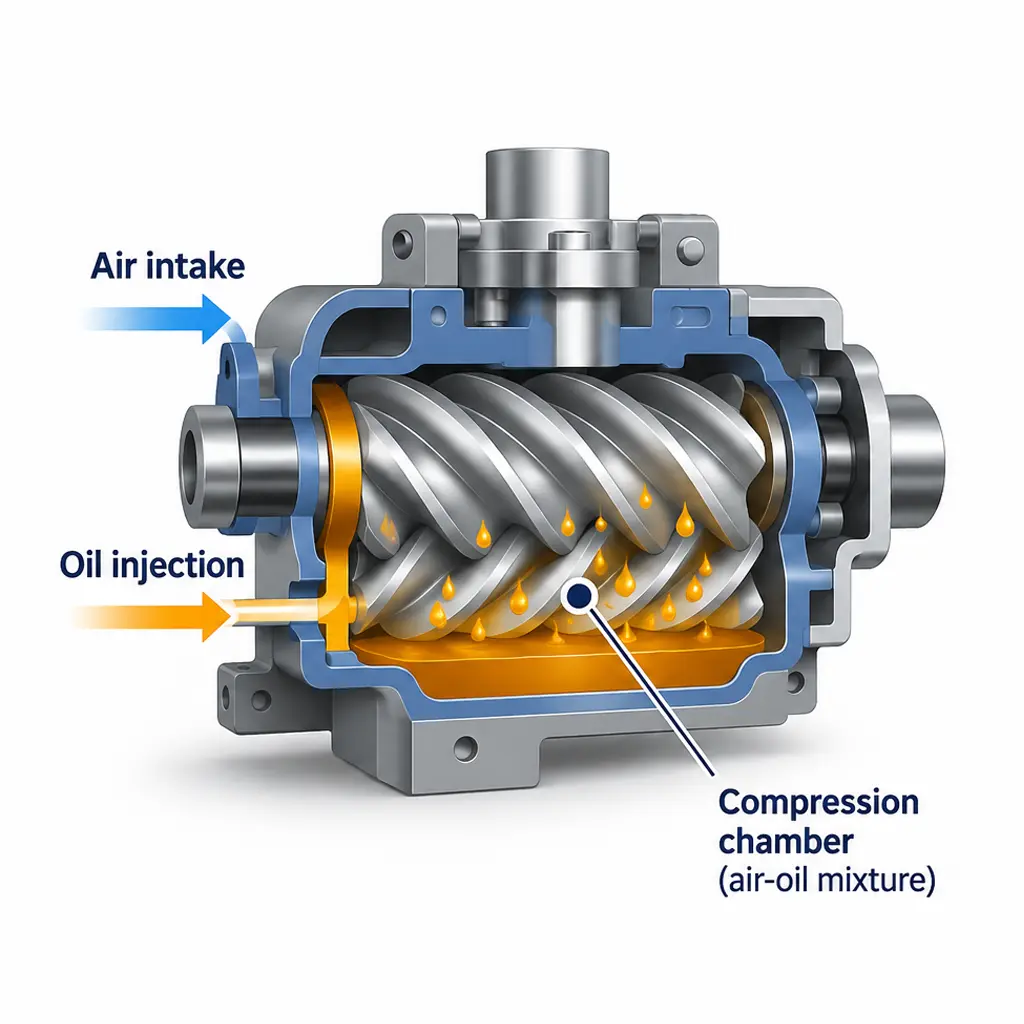
In oil-injected rotary screw and sliding vane compressors, oil is introduced into the compression chamber to perform several functions:
Lubrication of mechanical components.
Dissipation of heat generated during compression.
Sealing of internal clearances.
Reduction of friction and wear.
During compression, air and oil become mixed. The resulting mixture must be separated to allow the lubricant to be recovered and recirculated within the compressor.
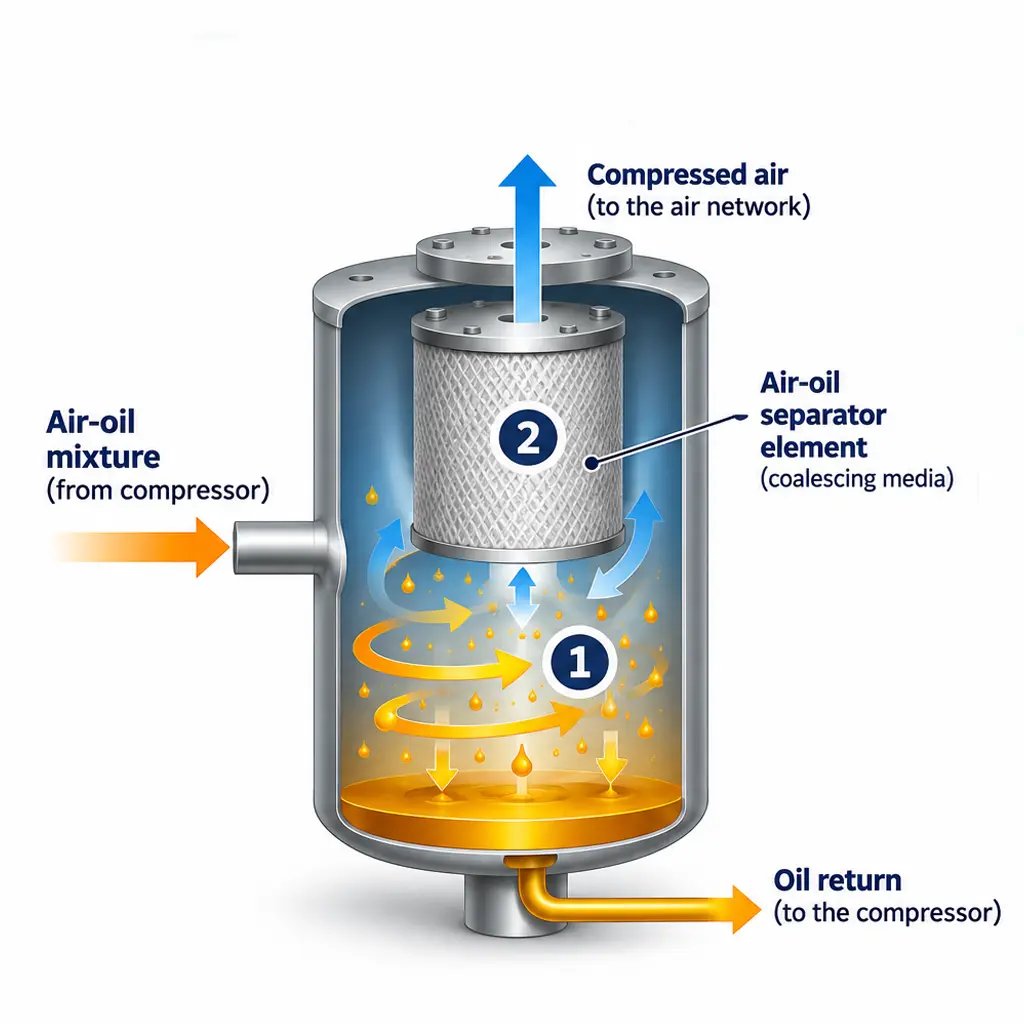
How air-oil separation works
The separation process generally takes place in two main stages.
Primary Separation
The air-oil mixture enters the separator vessel, where changes in flow direction and velocity, together with centrifugal and gravitational effects, help separate the bulk of the liquid oil from the compressed air.
However, fine oil droplets remain suspended in the air stream.
Secondary Separation
The compressed air passes through a dedicated air-oil separator element, which captures the remaining oil aerosol through a process known as coalescence.
The recovered oil is subsequently returned to the compressor lubrication circuit through a suitable oil recovery system.
The Principle of Coalescence
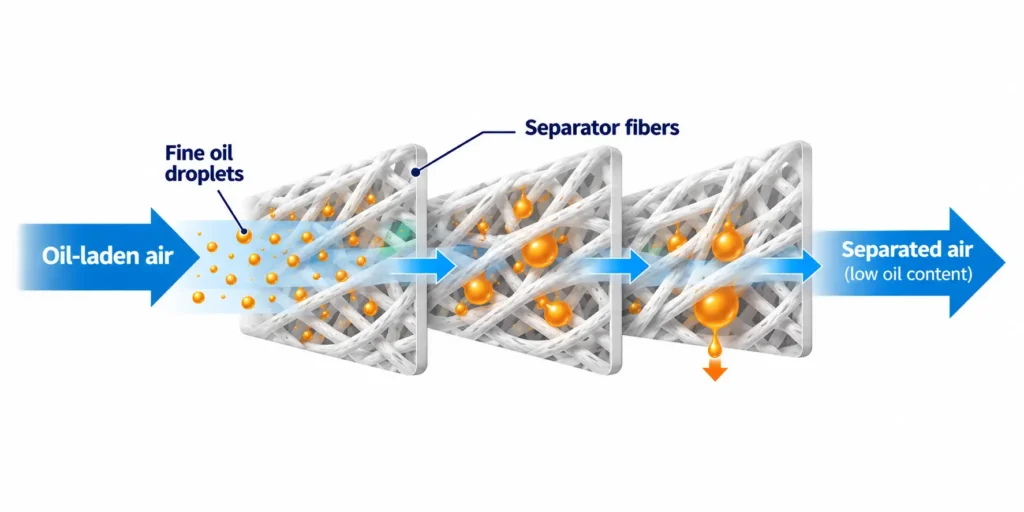
Coalescence is a physical separation process in which small liquid droplets combine to form larger droplets.
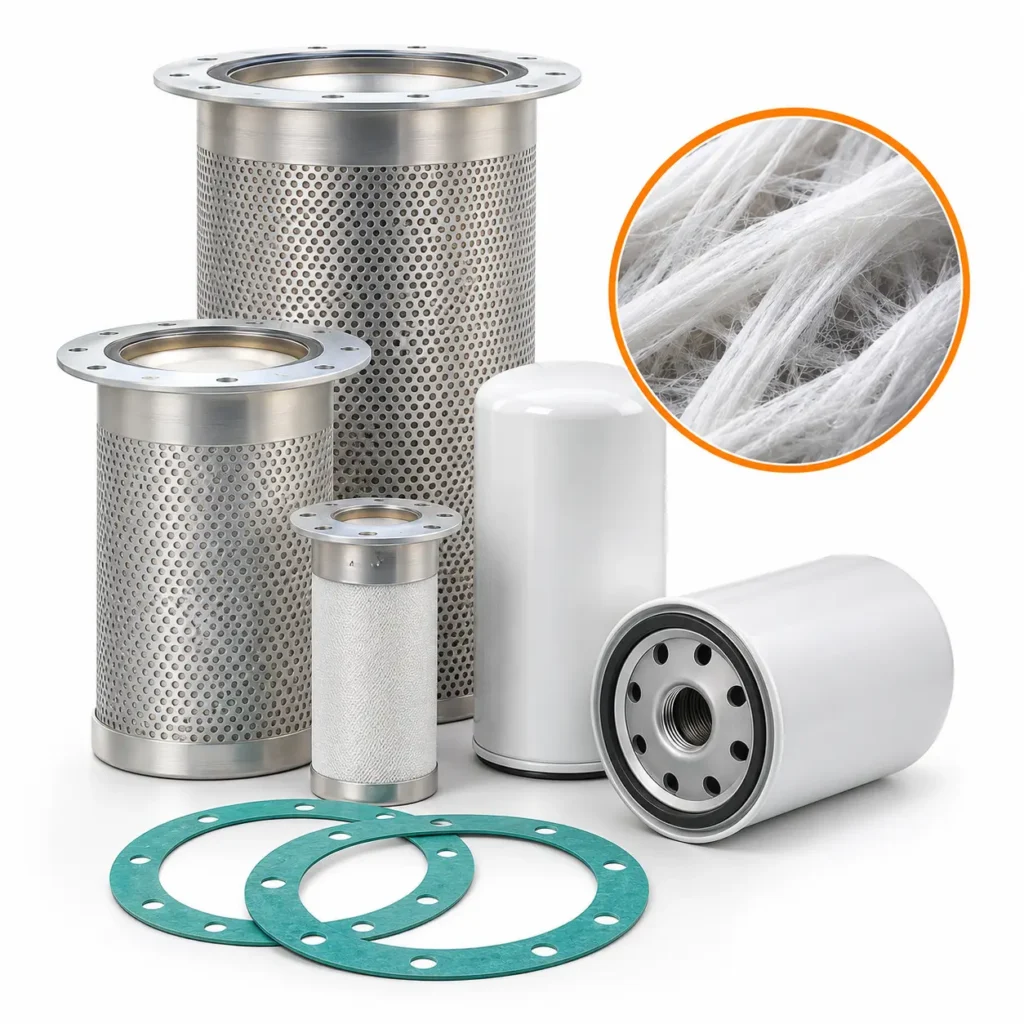
Air-oil separator elements typically use fine glass fibre media specifically designed to capture oil aerosols.
As the compressed air passes through the fibrous structure, oil droplets are intercepted and gradually combine into larger droplets. These can then migrate through the media, drain and be collected for recirculation.
This technology enables effective separation of oil aerosols, including droplets in the submicron range.
It is important to distinguish between oil aerosols and oil vapour. Coalescing separators remove liquid droplets but are not designed to remove oil in its vapour phase.
Where more stringent compressed air purity requirements apply, additional downstream treatment may be necessary.
Key Performance Parameters
The performance of an air-oil separator cannot be evaluated on separation efficiency alone. Several parameters must be considered together.
Residual oil content
The quantity of oil remaining in the compressed air after separation, commonly expressed in mg/m³.
Pressure drop
The differential pressure across the separator element. Excessive pressure drop can increase compressor energy demand.
Air flow rate
The volume of air passing through the separator under specified operating conditions.
Operating pressure and temperature
Both parameters influence air density, lubricant properties and separation behaviour.
Oil recovery
Effective drainage and lubricant recovery are essential to minimize oil consumption and maintain stable separator performance.
The impact of air-oil separation on compressor efficiency
An appropriately selected and correctly maintained separator contributes to:
Reduced oil carryover into the compressed air network.
Lower lubricant consumption.
Protection of downstream equipment.
Reduced energy losses associated with excessive pressure drop.
Reliable compressor operation.
Conversely, an incorrectly selected or deteriorated separator may lead to increased differential pressure, excessive oil carryover and higher operating costs.
Selecting the right air-oil separator
Separator selection requires a comprehensive understanding of the compressor design and its operating conditions.
Nominal air flow, operating pressure, temperature, lubricant characteristics, available installation space and oil recovery configuration should all be considered.
Borserini provides technical support in the selection of air-oil separation solutions, including standard wrap elements, depth separator elements and spin-on separators for oil-lubricated compressors.