

Engine air filters play an essential role in protecting engines from dust, dirt and airborne contaminants. In demanding operating environments, such as construction, agriculture and material handling, effective air filtration helps maintain engine performance, reduce unnecessary wear and support reliable equipment operation.
However, maintaining an engine air filtration system involves more than simply replacing a dirty filter. Understanding when to replace filter elements, how filtration efficiency changes over time and which servicing practices to avoid is essential for effective maintenance.
This guide explores key considerations for engine air filter maintenance and highlights common mistakes that can compromise filtration performance.
When Should an Engine Air Filter Be Replaced?
One of the most common misconceptions about engine air filters is that replacement should be based primarily on operating hours, mileage or visual appearance.
In many engine air filtration systems, the most reliable indicator is airflow restriction, measured using a dedicated restriction indicator or monitoring device.
As dust accumulates in the filter media, resistance to airflow increases. The filter should be replaced when the restriction reaches the threshold specified by the engine or filtration system manufacturer.
Best practices:
- Monitor airflow restriction using the appropriate indicator.
- Follow the engine manufacturer’s recommended replacement thresholds.
- Consider the operating environment and equipment duty cycle.
- Avoid replacing filters solely because they appear dirty.
Premature replacement can increase maintenance costs and unnecessarily expose the clean side of the air intake system during servicing.
How Filtration Efficiency Changes Over Time
Air filter efficiency is not necessarily constant throughout the service life of a filter element.
As particles accumulate on the filtration media, the deposited dust layer can improve particle separation efficiency. At the same time, however, the increasing dust load creates greater resistance to airflow.
This relationship between filtration efficiency and airflow restriction is important when determining the appropriate replacement interval.
A filter that appears dirty may still be operating effectively, while excessive airflow restriction can negatively affect engine operation.
Common mistake: Assuming that a visibly dirty filter must always be replaced immediately.
Best practice: Evaluate filter condition using the manufacturer’s specified airflow restriction limits rather than appearance alone.
Primary and Secondary Air Filters: Understanding Their Roles
Many heavy-duty engine air filtration systems incorporate both primary and secondary filter elements.
The primary air filter captures most of the airborne contaminants entering the system.
The secondary air filter, also known as a safety element, provides an additional level of engine protection, particularly during primary filter replacement or in the event of primary element damage.
Secondary filters generally require less frequent replacement than primary elements. However, their servicing intervals depend on the filtration system design and the manufacturer’s recommendations.
Unnecessary removal of the safety element can increase the risk of contaminants entering the clean air intake.
Best practices:
- Replace primary elements according to the specified maintenance criteria.
- Follow the manufacturer’s recommended interval for secondary filter replacement.
- Avoid unnecessarily removing or disturbing the safety element.
- Inspect the housing and sealing surfaces during maintenance.
Radial Seal vs. Conventional Air Filters
Air filter sealing technology plays an important role in preventing unfiltered air from bypassing the filter element.
Conventional axial seal filters typically use a compressed gasket to create a seal between the filter element and the housing.
Radial seal filters, by contrast, use a molded elastomeric sealing surface that fits against a cylindrical connection inside the housing.
This configuration can simplify installation and removal, often allowing filter replacement without additional tools.
However, the two sealing systems are not interchangeable.
Common mistake: Installing a filter element that appears dimensionally compatible but uses a different sealing configuration.
Best practice: Always verify the filter element’s compatibility with the specific air cleaner housing, including its sealing geometry and installation requirements.
An incorrect seal can allow unfiltered air to reach the engine, even when the filter media itself is functioning correctly.
Two-Stage Air Filtration Systems in Dusty Environments
In applications exposed to high concentrations of dust, two-stage air filtration systems can provide additional protection.
These systems combine preliminary dust separation with a primary filtration element.
During the first stage, heavier particles are separated from the incoming airflow, often through centrifugal action. Depending on the system design, the separated dust is collected or discharged through a dust evacuation valve.
The remaining air then passes through the primary filter element, where finer contaminants are captured before the air reaches the engine.
This arrangement can reduce the dust load reaching the primary element and help extend its service life.
Two-stage filtration systems are particularly relevant for equipment operating in construction, agriculture, earth moving and other dusty environments.
Best practices:
- Inspect dust evacuation components regularly.
- Ensure the dust evacuation valve is correctly positioned according to the manufacturer’s instructions.
- Check that dust discharge openings are not obstructed.
- Follow the recommended maintenance procedures for both filtration stages.
Common Air Filter Maintenance Mistakes to Avoid
Even a correctly specified filtration system can lose effectiveness if maintenance procedures are not followed.
Some of the most common mistakes include:
1. Replacing filters based only on appearance
A dirty-looking filter does not necessarily indicate that the specified airflow restriction limit has been reached.
2. Ignoring airflow restriction indicators
Failure to monitor restriction can result in filters being operated beyond their recommended service limits.
3. Removing the secondary filter unnecessarily
Disturbing the safety element during routine maintenance can increase the risk of contamination entering the engine.
4. Installing incompatible replacement elements
Incorrect dimensions, sealing geometries or housing compatibility can compromise filtration system integrity.
5. Neglecting sealing surfaces and housing cleanliness
Dust or debris on sealing surfaces can prevent proper installation and create potential leakage paths.
6. Incorrectly positioning dust evacuation valves
Improper orientation or blocked discharge openings can reduce the effectiveness of preliminary dust separation.
7. Applying incorrect clamp tightening torque
Excessive or insufficient tightening can damage connections or compromise sealing performance. Always follow the applicable installation specifications.
Supporting Reliable Engine Performance Through Proper Maintenance
Effective engine air filter maintenance requires a combination of correct filter selection, appropriate monitoring and careful servicing.
Rather than relying on fixed replacement intervals or visual inspection alone, maintenance decisions should be based on the operating conditions and the specifications provided by the engine and filtration system manufacturers.
Correct installation, compatible replacement elements and regular inspection of sealing surfaces and dust evacuation components all contribute to reliable filtration performance.
By adopting these practices, equipment operators can help protect engines, avoid unnecessary maintenance interventions and support long-term operational reliability.
Explore More About Engine Air Filtration
Looking for more detailed information?
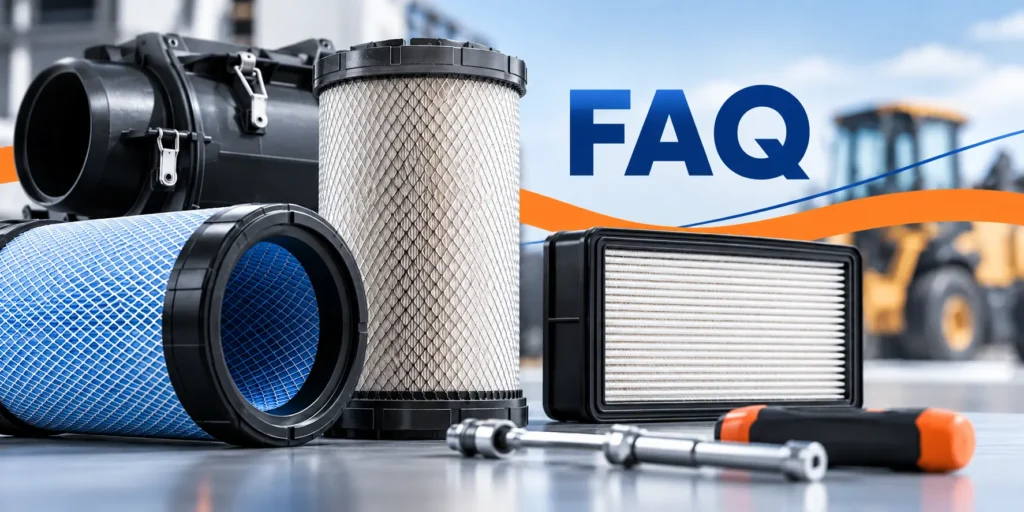
Explore our Air Filter Service & Maintenance FAQ for answers to common technical questions about filtration efficiency, replacement intervals, radial seal elements and two-stage air filtration systems.
You can also consult our Rectangular Air Filter – Service Instructions and Cylindrical Air Filter – Service Instructions for illustrated examples of filter maintenance procedures.
Discover Borserini’s Combustion Air Filtration solutions for industrial engines and demanding operating environments.